

On paper, owning property in Valencia is a great place to be. Rental demand is high, supply is tight, and your asset rises in value. But owning and managing are very different things. The moment a tenant moves in, your investment stops being a line in a spreadsheet. Soon it becomes a small daily business. That means tenant questions, repairs, early-morning calls, rental paperwork, handovers, and a lot of local know-how.
That is where a property manager helps. Yet many owners, above all from overseas, are not sure what a property manager in Valencia actually does, what it costs, or whether it is worth paying for. Some think it is just “sending a bill each month.” In reality, the job is far wider. It often decides whether your property is a calm, profitable buy or a constant worry.
Homevested looks after rental homes for owners across Valencia, as one of our core services. This guide explains it in plain terms. What does a property manager do? What should you expect to pay in 2026? How does it work when you live abroad? And how do you choose someone you can trust with your most valuable asset?

What Is a Property Manager?
A property manager is a person, or more often a company, that handles the day-to-day work of a rental property for you. They act as the link between you and your property. You stay the owner and the decision-maker; they handle the day-to-day work needed to keep the home tenanted, maintained and earning.
It helps to separate three roles that owners often confuse:
- An estate agent helps you buy or sell. Their job usually ends there.
- A property manager steps in once you own the property and stays involved for as long as you rent it out.
- A building manager (administrador de fincas) runs the shared building — façade, lift, stairs and communal areas — not your individual flat.
In short, a good property manager turns your investment into something close to truly passive, even though plenty of work goes on behind the scenes.
What a Property Manager in Valencia Handles Day to Day
The exact scope varies by provider. Generally, a full service in Valencia covers the duties below.
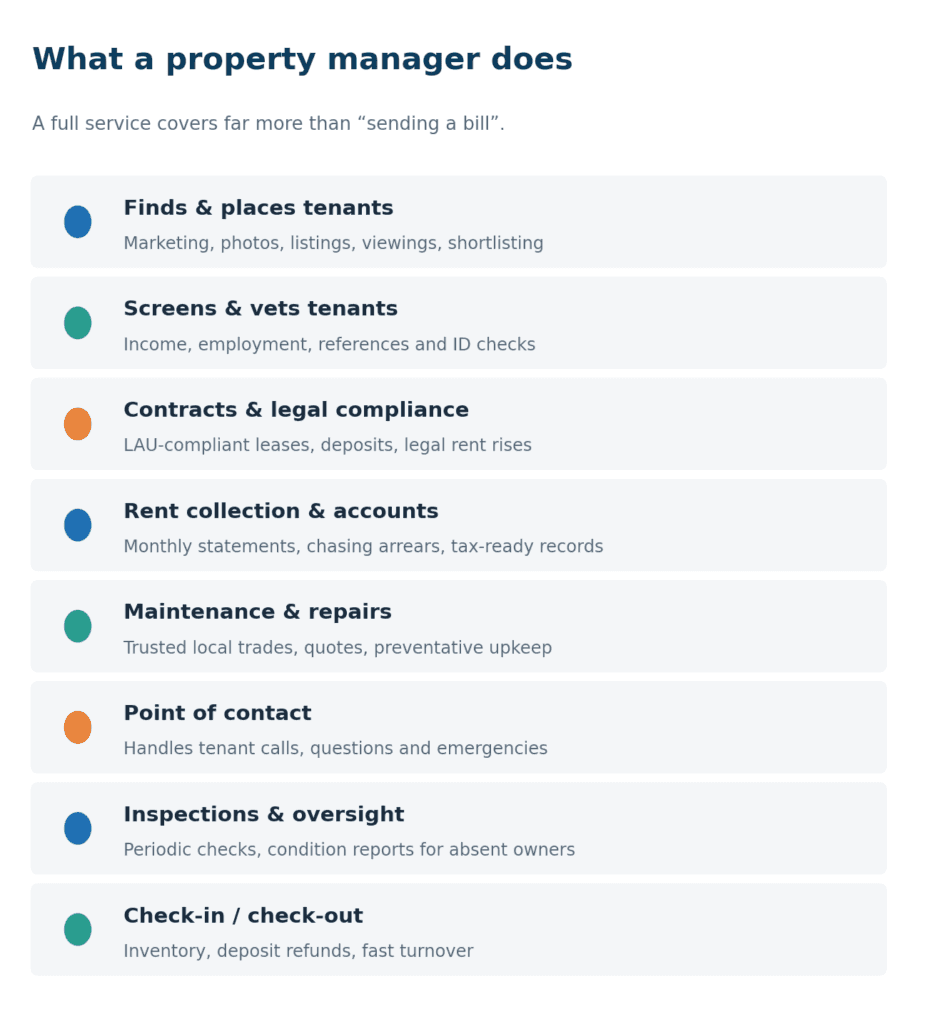
Finding and placing tenants. Before any rent arrives, you need the right tenant. The manager handles the whole let: photos, listing copy, the top portals, enquiries, viewings and a shortlist. In fact, good marketing is a skill, and a poor listing can sit empty for weeks.
Screening and vetting. Indeed, this may be the single most valuable thing a property manager does, and we cover it in detail below. A bad tenant can cost far more than an empty flat. An expert checks income, employment, references and ID to filter out problems early.
Rental paperwork and coordination. Spanish rental law is complex. Notably, it changed sharply with the Housing Law of 2023 (Ley de Vivienda). A manager makes sure your contract is drafted correctly under the Ley de Arrendamientos Urbanos. The right tenancy type is used. The deposit (fianza) is lodged with the regional authority. And annual rent rises stay within the legal index.
Rent collection and accounts. Then the property manager collects rent, chases arrears, and forwards your money with a clear monthly statement. Good managers also keep tidy rental records, so your income and expenses are easier to review.
Day-to-Day Running and Upkeep
Maintenance and repairs. Of course, taps drip and boilers fail, usually at the worst time. The property manager fields repair requests, draws on a network of trusted local trades, gets quotes, checks the work, and keeps you informed. Regular maintenance stops small problems becoming expensive ones.
Being the tenant’s point of contact. When something goes wrong, the tenant calls the property manager, not you. Indeed, for most owners that alone justifies hiring one. Emergencies, lease questions and noise complaints get handled quickly, in both the tenant’s and the owner’s language.
Inspections and oversight. Similarly, periodic inspections confirm the home is well kept and catch issues early. For absent owners, this is essential.
Check-in and check-out. At the end of a tenancy, the property manager inspects the home against the inventory. Then they handle the deposit refund and ready the home for the next tenant. That cuts the gap between lets.
Why a Good Manager Saves You Money, Not Just Stress
Still, some owners try to cut management costs. In fact, good upkeep is a step that protects and often grows your net return. Here is why.
It prevents costly voids. After all, an empty property earns nothing while still costing community fees, IBI, utilities and often a mortgage. A strong manager keeps it occupied, re-lets quickly when a tenancy ends, and shortens void periods. A few weeks of avoided vacancy a year can cover much of the fee.
It prevents expensive damage. Regular checks catch problems early. A small leak spotted on an inspection is a minor fix, not a ruined ceiling, mould remediation and compensated tenants months later.
It keeps out bad tenants. Similarly, careful screening cuts the risk of non-payment, damage, and the slow, costly court process to recover possession. One problem tenancy can wipe out years of fees.
It reduces avoidable risk. Rental mistakes can become expensive. An informed manager helps you stay organised, spot issues early, and know when to involve the right specialist.
It gives you your time back. As a result, the hours you would spend arranging repairs, chasing rent and answering messages return to you. For owners abroad or with demanding careers, that is the whole point.
How Much Does Property Management Cost in Valencia in 2026?
Price is usually the first question. Charges vary by provider and scope. Still, here is a realistic picture for long-term rentals in Valencia.
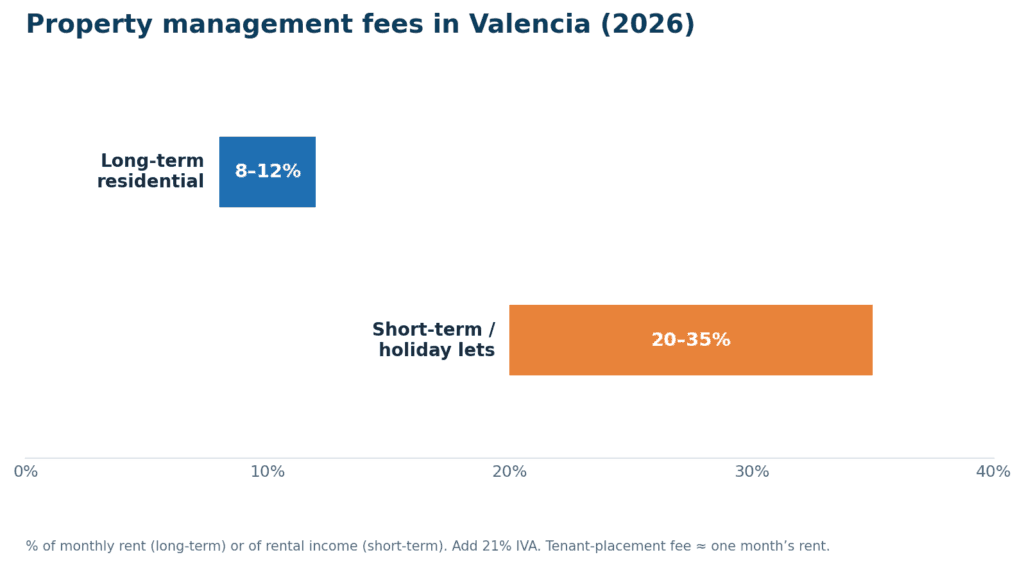
Generally, monthly fees for long-term residential property in Spain run between 8% and 12% of the rent, plus VAT (IVA). The lower end applies where vacancy is rare and the property needs little attention.
A tenant-placement (letting) fee may also apply when a new tenant is secured, historically around one month’s rent. Note an important change. Since the 2023 Housing Law, that agency fee can no longer be charged to the tenant on long-term lets. So it is now a landlord cost.
By contrast, short-term and holiday-let management costs more, typically 20% to 35% of income. The workload is far higher: frequent check-ins, cleaning, linen, guest messaging and fast turnover.
A few points worth understanding:
- Add the VAT. Fees normally carry 21% IVA on top of the headline percentage, so include it in your sums.
- Cheapest is not best. A rock-bottom fee can mean slow responses or a manager juggling too many properties. Ask what you get and to what standard, not just the price.
- Get the scope in writing. Partial management (rent only) costs less than full management (screening, inspections, maintenance, reporting, inspections, maintenance and rental coordination). Be clear what you are buying.
Weighed against avoided voids, prevented damage, fewer avoidable problems and your time saved, full management often pays for itself.
How Are Tenants Screened in Spain?
Screening deserves its own section, because it is where an expert adds the most value. In Spain, a solid process generally looks at:
- Income and employment. The big one. Rent should sit comfortably within income, usually no more than about a third of net earnings. Specifically, payslips (nóminas), contracts, or tax returns show this.
- Identity and documents. Confirming who the person is (via DNI, NIE or passport) and their legal residence status.
- References. Contacting former landlords and, where useful, employers.
- Guarantees and extra security. In addition, a deposit of up to one month’s rent applies, plus further guarantees within the legal maximum. Sometimes a guarantor (avalista) or unpaid-rent insurance is added too.
- Stability. Beyond the numbers, a manager’s experience helps judge whether the tenancy looks steady and likely to last.
Screening is a balancing act. It must be thorough enough to protect you, yet fair and within the law. An expert knows where that line sits, and that the goal is not just a tenant, but the right tenant.
Managing Your Property Remotely
Notably, much Valencia property belongs to non-residents, with many investors based outside Spain entirely. If you are buying from the Netherlands, Germany, France or further afield, the obvious question is: how is the property managed when you cannot be there?

The honest answer: it can run just as well from abroad, sometimes better. Money you might spend living nearby goes further when a good manager becomes your eyes and hands. Remote management works because of a few things:
- A local on the ground. Your manager, based in Valencia, can visit the property, meet trades, run inspections and handle emergencies in person — none of which you could do from abroad.
- Regular, transparent reporting. Monthly statements, inspection reports and photos, and a quick update whenever a decision is needed. You stay informed without being on call.
- A clear decision framework. Good arrangements set in advance what the manager can handle alone (say, repairs up to an agreed limit) and what needs your approval. Small issues get solved fast; you keep control of the big ones.
- Help with the bigger picture. A manager can keep your rental records, reports and property updates organised, so you have clear information available when speaking with your own adviser.
This is truly hands-off ownership: you get the income and the reports, and someone you trust handles the rest.
Property Management for Foreign Investors
For overseas investors, then, good management is not just useful. It is essential. If you buy in Valencia for rental income and capital growth, you want a clean, passive return, not a part-time job in another country.
A good property manager lets a foreign investor:
- Stay truly passive, receiving net income without daily involvement.
- Stay organised in an unfamiliar rental market, with local support for the practical side of letting and clear reminders when specialist advice may be needed.
- Protect the asset from a distance through inspections and preventative maintenance.
- Bridge the language and culture gap, dealing with tenants and trades in Spanish.
- Make better calls, with local advice on rents, timing and value-adding upgrades.
In short, professional management turns an overseas property from a worry into the simple investment you planned. If you are still weighing the numbers, our guide to realistic rental returns in Valencia is a useful companion read.
How to Choose the Right Property Manager in Valencia
However, property managers are not all equal. Before you hand over your asset, ask the right questions:
- What is actually covered? Get it in writing. Is it rent collection only, or does the fee include screening, maintenance, inspections and rental coordination?
- How and how often will you update me? Expect regular reporting, above all if you are overseas.
- What is your tenant screening process? A vague answer is a warning sign.
- What is your maintenance network? Generally, established managers have trusted, pre-vetted trades and can act fast.
- What happens in an emergency? Ask what they would do at 11pm on a Sunday when a pipe bursts.
- What are the all-in costs? Management percentage, letting fee, VAT and any extras — everything, up front.
- Do you know my area? Local knowledge shapes pricing and demand.
Ultimately, the best property manager is rarely the cheapest. It is the one who is open, responsive, up to date, and treats your asset as if it were their own.
Rental Rules in Spain: Why Good Coordination Matters
The legal side is where owners most often slip up, often without realising until it is too late. In practice, Spanish rentals run on the Ley de Arrendamientos Urbanos (LAU), reshaped by the 2023 Housing Law (Ley de Vivienda). The rules are detailed and easy for an outsider to get wrong.
Consider just a few things a manager must get right. The contract type matters: a long-term home lease (vivienda habitual) gives very different protections from a seasonal one. The fianza has strict rules. A home deposit is one month’s rent. In many cases it must be lodged with the regional deposit office, not simply held by the owner. Annual rent rises are capped and tied to an official index. Notice periods to end a tenancy are fixed. And agency fees can no longer be passed to the tenant on long-term residential lets.
Get any of this wrong and the fallout is serious: void clauses, unenforceable contracts, disputes, fines, and a weaker position if a tenancy turns bad. Keeping you safely within the rules, and ready when the law changes, is the manager’s job. For an absent owner above all, that alone can justify the cost. You can read the law itself via the official Boletín Oficial del Estado.
The Hidden Cost of Self-Managing From Abroad
At first, many owners plan to manage alone. For a few — locals with plenty of time — it works. But it is worth being honest about what self-management really costs, even when no one sends you a bill.
There is the time: advertising, enquiries, viewings, contracts, chasing rent, finding trades, supervising repairs, inspections, and replying to tenants. None of it is hard on its own. Together it quietly eats your hours and attention.
There is the knowledge: understanding the practical rental process, contract types, tenant expectations and when specialist advice may be needed. Mistakes here are expensive, and ignorance is no defence.
And there is the distance — the part foreign owners feel most. For instance, say a tenant calls about a dead boiler and you are in another country. You cannot show the plumber the problem, oversee the work, or check the invoice in person. You are juggling a foreign system in a foreign language across a time gap, with a low hum of worry about a home you cannot see.
For some owners, none of that outweighs the saved fee. For most — especially the non-resident who bought for passive income — letting a professional carry the load is not a luxury. It is the line between a worthwhile investment and one that quietly erodes your quality of life.
What a Great Property Manager Does Differently
Once you decide to hire, quality becomes everything, because “management” can mean many things. Small details separate an outstanding manager from an average one.
First, a great property manager is proactive, not reactive. They inspect, anticipate and suggest fixes before a small issue becomes a big bill. They will flag when your rent has slipped below market, or when a modest upgrade could lift both rent and value.
Equally, a great property manager is transparent. Statements arrive on time, reports are clear, and when a decision is needed you get the full picture so you can choose well.
Likewise, a great property manager has a real local network of reliable trades who turn up, do good work at a fair price, and can get things sorted.
Finally, a great property manager treats your property as an asset to protect, not a cash cow. They think about its future condition and value, not just this month’s rent. And they are straight about money: clear prices, no hidden mark-ups on jobs, no surprise extras.
How Homevested Manages Your Valencia Property
Our service rests on one promise: peace of mind for owners. We handle the detail — tenant placement, reporting, regular visits, upkeep and more — whether you live down the street or across the globe.
We work closely with overseas investors and non-resident owners. So we know what real hands-off ownership needs: clear reporting, quick advice, good local trades, and a manager who knows every corner of Valencia. Our aim is simple: protect your asset, minimise voids, and maximise the return on the home you bought. If you are buying or selling rather than letting, our guide to valuing your property in Valencia will help.
Frequently Asked Questions
What does a property manager actually do?
A property manager runs your rental for you. That means viewings, tenant coordination, rent tracking, repairs, inspections and check-in/check-out. Finally, they act as the tenant’s point of contact, and manage check-in and check-out.
How much does property management cost in Valencia?
For long-term rentals, fees in Spain run 8% to 12% of the monthly rent plus 21% IVA, often with a separate tenant-placement fee. Short-term and holiday lets cost more — roughly 20% to 35% — because they are far more hands-on. Always check what is included.
Are property managers worth the money?
For most owners, yes. Good management avoids costly voids, catches maintenance early, screens out problem tenants, keeps the rental process organised, and saves you significant time. For busy owners and foreign investors, it is what makes the investment truly hands-off.
Can I manage a Valencia property if I live in the UK?
Yes — and this is one of the main reasons to use a manager. A local property manager becomes your eyes and hands: visiting the property, meeting trades, handling emergencies, sending inspection reports and keeping you updated with statements. With decision limits agreed in advance, ownership can be very hands-off.
How do managers screen tenants?
Usually a manager checks income and employment, through payslips, contracts or tax returns. Next they confirm who the person is, take references from past landlords, and arrange guarantees. Those can include an agreed deposit, a guarantor or rent-default insurance. The goal is a reliable, secure tenant, fairly and legally chosen.
What is the difference between a property manager and a community administrator?
A property manager looks after your own rental — your tenants, lease and maintenance. A building manager (administrador de fincas) runs the shared building for all owners: lift, stairs, entrance and façade. They are separate roles, and you may have both.
Talk to Homevested About Managing Your Property
There is no such thing as a bad property — only properties that are better managed than others. Whether you own a single Valencia apartment or a large portfolio, professional management can make it a truly profitable, hands-off experience. Homevested handles the tenants, the maintenance, the reporting and the messages, so you can simply own your property. Get in touch with our team to talk it through.