

If you have ever typed “how much is my house worth” into Google, you are not alone. It is one of the most searched property questions in Spain. An accurate property valuation in Valencia is the starting point for almost every smart decision you make as a seller. Your home is probably the largest asset you will ever own, so its true value shapes everything that follows.
At Homevested we talk to Valencia property owners every week who just want an honest answer. This guide gives you one. We will walk you through how property valuation works in Spain, how Valencia’s market looks in 2026, what drives your home’s value, the real costs of selling, and how to get a valuation you can trust.
Whether you own an apartment in Ruzafa, rent out a house in Benimaclet, or hold a villa on the city limits, by the end of this article you will know how much your property is really worth and how to make the most when you sell it.

Why a Property Valuation in Valencia Matters More Than You Think
It is tempting to treat valuation as simply picking a number, listing the home, and waiting. But that first number defines the rest of the sale.
Price your house too high and it sits on the market. Buyers scroll past it, portals push it down the results, and after a few flat months you end up reducing it anyway. By then the listing looks stale, and buyers start to wonder what is wrong with it.
Homes that launch at a realistic level sell faster. They also sell closer to the asking price than homes that start too high.
Price it too low and you hit the opposite problem. You may sell quickly, but you leave thousands of euros on the table that you can never recover.
A fair price helps in other ways too. It tells you what you can reasonably ask, it strengthens your hand when you negotiate, and it lets you work out your real net proceeds after taxes and fees. As you will see later, the sale price and the money you actually keep are two very different figures.
In short, a property valuation is not paperwork. It is the single most important decision of your sale.
How Property Valuation Works in Spain
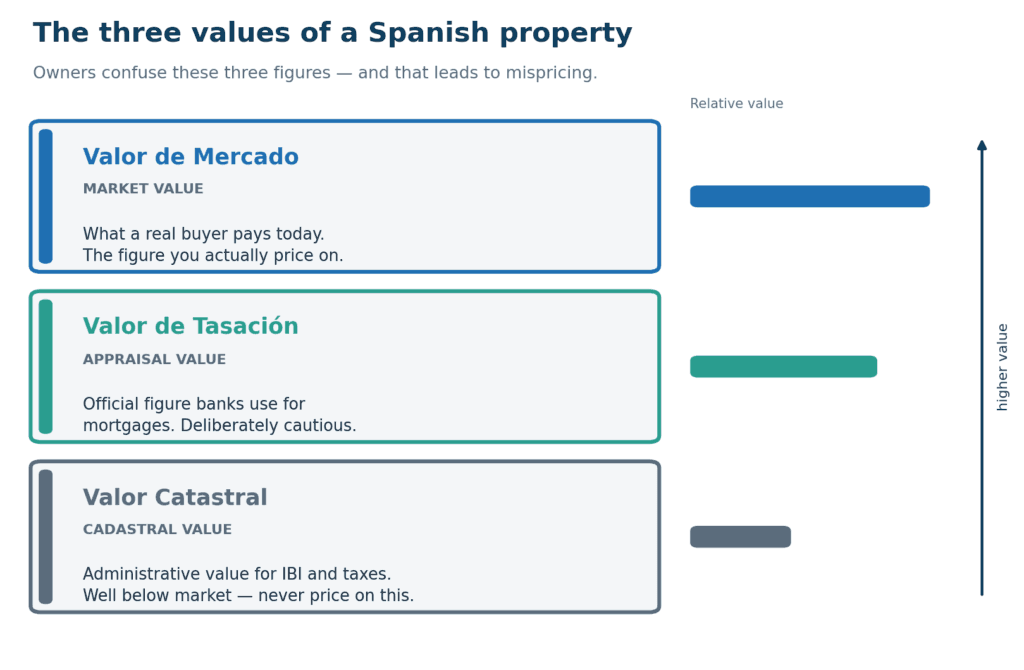
Before we focus on Valencia, let us look at the three “values” of a Spanish property. Owners often confuse them, and that confusion leads to poor pricing decisions.
1. Market Value (Valor de Mercado)
This is what most sellers really want to know. It is the price a serious buyer would pay for your home in today’s market. Supply and demand, condition, location, and the actual sale prices of similar homes all shape it. It is the realistic ceiling for what you can list and sell for.
2. Cadastral Value (Valor Catastral)
The Spanish authorities (the Catastro) set this administrative value. They use it to calculate your annual IBI (council tax) and other local taxes. It usually sits well below market value, and you should never use it to price a home for sale. You will find it on your latest IBI receipt.
3. Appraisal Value (Valor de Tasación)
An accredited, regulated appraisal company produces this figure through an official appraisal, or tasación. Banks require one before they grant a mortgage, because it tells them what your property is worth as collateral. Spanish law sets a strict process, and the result comes as a formal report. It is the highest “official” number, but by design it stays cautious, so it may not match true market value.
The Comparison Method: How Valencia Homes Are Actually Valued
For standard apartments and houses, agents in Spain mainly use the comparison method (método de comparación). The principle is simple. An agent looks at roughly six homes similar to yours in location, size, age, and condition that have sold or are on the market. They work out an average price per square metre, then adjust that figure for the specific qualities of your home.
Other methods exist. The cost method, for example, measures what it would take to rebuild the property minus depreciation, plus land value. Agents mainly reserve it for new builds or unusual homes with few comparables. For the vast majority of Valencia homes, the comparison method is the one that matters.
This is exactly why local expertise counts. An experienced local agent knows the most desirable streets, where prices are heading, and how one block compares to the next. A spreadsheet cannot tell you that. A professional can.
The Valencia Property Market in 2026: Where Prices Stand
Valencia is one of the liveliest property markets in Europe right now. If you are thinking of selling, you are in a strong position. Knowing current prices helps you set a sensible target for your own property valuation in Valencia.
What the Numbers Say
According to Idealista’s price data, the average price in Valencia city hit a record €3,238 per square metre in late 2025. That is up around 15% year on year. The market passed the €3,000 per square metre mark for the first time in mid-2025.
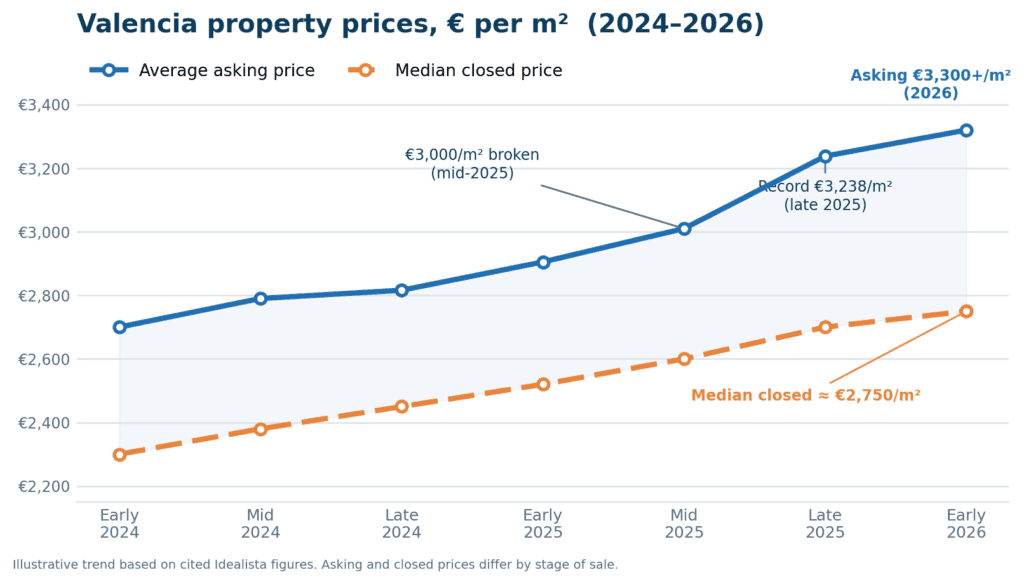
Asking prices have kept rising into 2026, with some reports putting the city average above €3,300 per square metre. Prices vary hugely by district, though. Central areas such as L’Eixample command the highest figures, while the outer southern and northern districts cost far less. Well-connected, characterful areas like Ruzafa and the Old City (Ciutat Vella) stay consistently expensive.
Different sources quote different averages because they measure different stages. Asking prices on portals run higher than actual closed prices, and closed prices tend to sit below official appraisal values. A realistic median closed rate for Valencia in early 2026 lands somewhere near €2,750 per square metre, well below the headline asking figures. That gap is exactly why a professional property valuation pays off. It bridges the distance between what owners hope for and what buyers actually pay.
Why Valencia Stays Strong
A few clear drivers explain the city’s strength:
- Scarcity. Central and prime areas simply do not have enough homes to go round. Construction is slowly recovering, but expensive land and high building costs have already pushed asking prices up.
- Strong international demand. Buyers from the Netherlands, Germany, France and Latin America keep coming for the climate, the culture, and prices that still beat Madrid and Barcelona per square metre.
- Spreading demand. As core areas grow pricey and supply tightens, buyers look outward. That spreads demand to the suburbs and lifts prices across the whole metropolitan area.
What to Expect in 2026
Growth looks set to ease in 2026. The double-digit jumps of 2025 do not appear sustainable. Even so, tight supply and steady demand should keep the market firmly on the seller’s side. For most owners, that makes this a favourable time to sell, and a current property valuation in Valencia more useful than ever.
The Key Factors That Decide Your House’s Market Value
Every property is different, and dozens of factors combine to set its value. Here are the ones any thorough property valuation in Valencia weighs carefully.
Location, Location, Location
Location is the single biggest factor in any property valuation, anywhere in the world, and Valencia is no exception. The feel of each district varies sharply. One block can be worth noticeably more than its neighbour. Homes closer to the historic centre, the Turia Gardens, the beach, good schools and metro stations carry more value. A good local “vibe” pushes prices up too, because people happily pay a little more to live there.
Size and Layout
The headline figure is the total built area in square metres, but layout matters just as much. A well-planned home with bright, functional rooms beats a poorly laid-out property of the same size. The number of bedrooms and bathrooms counts as well. Three-bedroom homes are the most sought-after in Valencia, and extras like terraces, balconies, storerooms (trasteros) and parking all add value.
Condition and Age
Condition, age, and build quality have a direct impact on value. A refurbished, move-in-ready home commands a premium, because most buyers pay extra to avoid the cost and hassle of renovation. A property that needs major work fetches less, and buyers will deduct their expected refurbishment costs from any offer.
Floor Level, Light and Views
In an apartment building, higher floors usually fetch more, and a building with a lift commands a premium. Light matters too. A home with excellent natural light and a street or courtyard view beats one that looks onto a light well. Outdoor space and orientation, including where the sun falls through the day, also count.
Energy Efficiency
The Energy Performance Certificate (Certificado de Eficiencia Energética) is a legal requirement to sell or rent a home in Spain. Energy efficiency increasingly affects value too. A better rating signals lower running costs to buyers, and it is becoming a real selling point.
Building and Community Factors
The wider building matters: the facade, the roof, the lift, and the communal areas. So do the monthly community fees and any major works (derramas) on the horizon. A well-kept building with reasonable fees supports a higher value.
Legal and Documentary Factors
A valuer also checks whether the property is “clean” in legal terms. They confirm that it matches its entry in the Land Registry (Registro de la Propiedad) and the Catastro, that any changes are registered, that no charges or debts sit against it, and that planning rules do not limit its use. If a protection plan or architectural listing restricts the property, it pays to find out early, because it can cause delays or even derail a sale.
The Wider Market
Finally, factors well beyond your own four walls play a part. The state of the economy, mortgage rates, how freely banks lend, buyer demand for your type of home, and the level of competing stock when you sell all shape the result. Timing the market can help here too.
How to Get a Property Valuation in Valencia (and the Limits of Each Method)
These are the most common ways owners answer “how much is my house worth.” Each one has a role to play, and each one has its limits.
Online Valuation Tools and Price Simulators
Plenty of free online tools exist. You enter your address, size, number of rooms and condition, and the tool generates an instant estimate, usually from average price-per-square-metre data for the area. As a first reference they are genuinely useful. In under a minute, and for free, they give you a rough idea.
But the drawbacks are real. These tools work from averages and know nothing about your specific home. They cannot tell that you have just refurbished, that you overlook a park rather than a main road, or that the block replaced its lift last year. Bank tools are even less reliable. Two apps will often value the same flat very differently. Treat the online figure as a broad guide only.
Bank Appraisals (Tasación)
A formal tasación from a certified appraiser is rigorous, and the mortgage lender relies on it. If you need an official figure in writing, this is the best measure. Remember, though, that an appraisal stays deliberately conservative. It serves the lender’s risk analysis, not your sale. It usually costs several hundred euros and takes a few working days.
The “Ask Three Agents” Approach
Many sellers invite several agents to value their home. Sometimes this works, because agents compete to give their best figure. But watch out: some quote an inflated number purely to win the listing. They then spend the following months pushing you to drop the price. The figure an agent gives you should always be honest, even when it is not the highest.
A Professional, Local Property Valuation in Valencia
The best answer marries solid data with local knowledge. With a Homevested property valuation in Valencia, a real person visits your home, inspects it closely, checks the documentation, and compares it against genuine recent sales in your specific neighbourhood, not city-wide averages. This is the figure you can build a sale around, and it is exactly what we offer property owners across the city.
Homevested also works with a platform that collaborates with notaries across Spain. Through this partnership, the platform draws on verified transaction data shared by the notaries, so we can see exactly what comparable properties have recently sold for. That gives you highly accurate market insight and pins down your home’s true value from real sale prices, not just asking prices.
How Much Will It Cost You to Sell? Working Out Your Net Proceeds
Many sellers learn too late that the sale price is not the sum that lands in their bank account. In Spain, several taxes and fees sit between the two. A practical property valuation conversation should therefore include an estimate of your real net proceeds, the money you actually walk away with. In 2026, these are the main costs to plan for.
Capital Gains Tax (IRPF / IRNR)
If you sell for more than you paid, the profit attracts capital gains tax. In general, the gain equals the sale price minus the purchase price, minus any allowable costs and improvements you can prove with receipts.
- Spanish tax residents pay capital gains tax in bands, starting at 19% and rising from there.
- Non-residents usually pay a flat rate of 19%.
Reliefs do exist, including main-home relief, rollover relief when you buy a replacement home, and an exemption for over-65s selling their main residence. All of them come with conditions, so always check your case with a tax adviser.
The 3% Retention for Non-Resident Sellers
If you are a non-resident, the buyer must withhold 3% of the sale price and pay it to the Spanish Tax Agency as an advance on your capital gains tax. After completion, you file a return and calculate your actual gain. If you overpaid, you reclaim the difference. If you underpaid, you settle the rest. This retention is a key cash-flow point for non-resident sellers, so plan for it.
Plusvalía Municipal
The town hall charges this local tax on the rise in value of the urban land under your property between the dates you bought and sold. Since a major reform, you can choose between two ways to calculate it: an objective method based on the cadastral value of the land, or a real method based on the actual gain. You pay whichever is lower. If you sell at a loss or break even, you may be exempt, but you still have to declare it with proof. The seller pays this tax, and you generally have to report it within 30 days of the sale.
Other Costs
A few more costs round out the picture:
- Energy Performance Certificate. A relatively small cost, but a legal must before you market the home.
- Legal or gestoría fees. Many sellers hire a lawyer or gestor to handle the paperwork, retentions and filings. It is especially useful for remote and non-resident sellers.
- Mortgage cancellation. If a mortgage still sits on the property, expect notary and registry costs to cancel it formally, plus any bank fees.
- Estate agent fees. The commission you pay for marketing and selling the home.
The bottom line: ask for a detailed breakdown of these costs before you finalise a sale, so you know your real net figure. A good adviser keeps records of your purchase costs and improvements, because those offsets can cut your capital gains bill significantly.
Tax rules and local coefficients change, and every situation differs. Treat the figures above as a 2026 guide, not personal tax advice. Always check your own details with a qualified tax expert or lawyer.
How to Get the Most Accurate Property Valuation in Valencia
Here is the simple, step-by-step method we recommend to any owner who wants an honest answer to “how much is my house worth.”
- Start with an online estimate. Use a free tool for a rough ballpark. It gives you a starting point, but treat it as nothing more than that.
- Gather your documents. Get your title deed (escritura), your latest IBI receipt, your Energy Performance Certificate, the nota simple from the Land Registry, and receipts for any big repairs or improvements. Having them ready makes every later step faster and more precise, and the improvement receipts can lower your tax bill.
- Research recent comparable sales. Look at what similar homes actually sold for in your neighbourhood, not what they are listed at. Closed prices tell you far more than asking prices.
- Arrange a professional property valuation. Ask an expert local specialist to view the property. No algorithm captures condition, light, layout and dozens of subtle factors. Only a visit does.
- Get the net-proceeds picture. Ask your valuer to fold in the selling costs, so you know not just the headline price but the total you will keep.
- Be honest about condition. Buyers feel none of your attachment to the home. An honest read on condition leads to stronger results, and small, cheap fixes before listing can go a long way.
How Homevested Helps You Sell for the Best Price
Homevested gives Valencia owners dedicated, personal service. If you are even thinking about selling, your first step costs nothing and commits you to nothing: get an accurate value on your property.
Our property valuation service gives you a current, evidence-based figure, grounded in real local sales and a proper inspection of your home rather than a basic formula. That is only the start. Our sale support service then guides you through the whole journey, from market assessment and premium marketing to viewings, negotiations, and completion.
We work with local and international owners selling across the city, we know Valencia gem by gem, and we keep three simple goals: the smoothest sale, the most confident seller, and the best price, with full clarity on what you take home. You can also read our guide to choosing the right Valencia neighbourhood if you are weighing where to buy next, or our breakdown of realistic rental returns in Valencia if you plan to invest the proceeds.
Frequently Asked Questions
How can I value my house for free?
Start with a free online estimate, then book a free professional property valuation in Valencia with a local agent. Agencies like Homevested offer this. The online tool gives you a quick rough idea, while the professional valuation, based on a visit and real local sales, gives you a figure you can confidently price to.
Can I trust online valuations?
Online valuations are a good place to start, but never treat them as your final price. They run on averages, so they cannot see your home’s condition, light, layout, or recent upgrades. Bank valuation apps are notoriously inaccurate and often miss the market badly. Always get a professional figure.
What is the difference between cadastral value and market value?
The cadastral value is an administrative figure used for taxes like IBI, and it almost always sits below market value. The market value is the price a realistic buyer will pay for your home today. Never price your home for sale on the cadastral value.
What does it cost to sell a house in Spain?
Plan for these costs: capital gains tax (19% flat for non-residents, banded for residents), Plusvalía Municipal, the Energy Performance Certificate, any legal or gestoría fees, mortgage cancellation costs if you still have a loan, and estate agent fees. Non-resident sellers should expect a 3% retention at completion, paid to the tax authorities as an advance. Always work out your net proceeds.
Should I sell my property in Valencia in 2026?
Valencia has one of the strongest markets in Europe. Prices grew strongly through 2025, and some growth should continue in 2026 at a more moderate pace. Demand stays steady while supply stays tight, which keeps conditions favourable for sellers. To know where your own property stands, get a property valuation now.
How long does it take to sell a house in Valencia?
There is no single answer. It depends on price, location, condition and presentation. The biggest driver of a quick sale is setting the right asking price from day one. Correctly priced homes sell faster, and they fetch a higher share of the asking price than homes that launch too high and drop later.
Find Out What Your Property Is Really Worth
The honest answer to “how much is my house worth” is not a number you pull from a quick search. It rests on real local expertise, up-to-date market data, and an accurate read on your individual property. That is exactly what we offer.
Call Homevested today for a free property valuation in Valencia. We will give you an honest figure, explain the costs of selling, and map out the best route to a quick sale. Get in touch with our local team to get started.