


Buying in Valencia does not have to mean paying all cash. A mortgage in Spain for non-residents is very doable in 2026, and Spanish banks lend to foreigners every day. The rules are just a little different from those for residents, and knowing them upfront saves time and surprises. This guide covers how much you can borrow, the rates, what you need, the costs and the process, with a worked Valencia example.
It is written for non-resident buyers, whether you are moving over, buying a holiday home or investing. We keep the numbers realistic and the steps clear.

Signing for a Spanish mortgage: very doable as a non-resident with the right paperwork.
Can a non-resident get a Spanish mortgage?
Yes. Spanish banks actively lend to non-residents, including buyers from the EU, the UK, the US and beyond. You do not need to live in Spain or hold residency. You do need a NIE (your foreigner tax number), a clear income picture and a larger deposit than a resident would put down. The process is straightforward with the right paperwork, and many banks have English-speaking international desks.
How much can you borrow?
This is the biggest difference for non-residents. Banks lend against loan-to-value (LTV), and non-residents are generally capped at 60 to 70 percent of the price or the bank's valuation, whichever is lower. Residents can often borrow 70 to 80 percent. So as a non-resident, plan for a deposit of around 30 to 40 percent of the price, plus the buying costs on top.
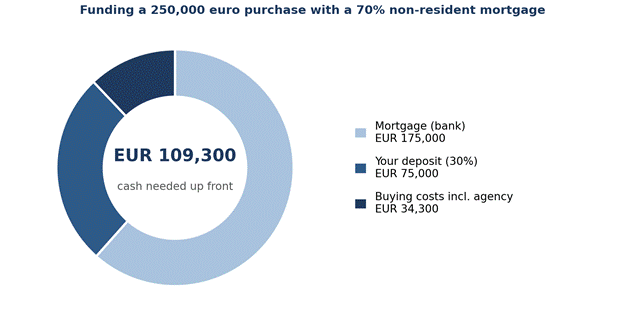
Figure 1: On a 250,000 euro purchase with a 70% non-resident mortgage, you fund the deposit and the buying costs in cash, around 109,300 euros.
One catch to watch: the bank lends on the lower of the price or its own valuation (tasacion). If the valuation comes in below the price you agreed, your deposit has to cover the gap, so it rises. Build a little headroom into your budget for that.
Rates in 2026
Rates are competitive again. In 2026, non-residents typically see fixed rates around 3.2 to 3.5 percent for the full term, with some sharper offers lower. Variable rates track Euribor plus a margin and land around 3.5 to 4.5 percent. Mixed mortgages, fixed for the first few years then variable, are common too. Non-residents are often quoted slightly higher than residents, reflecting the bank's added risk and compliance, so it pays to compare offers or use a broker.
What you need to qualify
Banks want to see that the repayment sits comfortably within your income. As a rule, they cap total loan repayments at around 30 to 35 percent of your net monthly income, counting any debts you already have. Typical paperwork includes:
- Your NIE and passport: both are needed to borrow and to buy.
- Proof of income: recent payslips and an employment contract, or business and tax accounts if you are self-employed.
- Tax returns: usually the last one or two years; EU documents are often accepted without translation.
- Bank statements: recent months, to show income and outgoings.
- Existing debts: a summary of any loans or mortgages elsewhere, since these affect your limit.
Non-residents usually borrow over a shorter term than residents, often up to 20 to 25 years, and banks want the loan cleared by around age 65 to 75. A valuation (tasacion) is mandatory and costs roughly 300 to 500 euros.
The costs, and who pays them
Good news since 2018: the bank, not the buyer, pays the tax, notary and registry costs of the mortgage deed itself. You still pay the valuation, and sometimes an arrangement fee (comision de apertura). Separately, you pay the normal costs of buying the property, purchase tax, notary, registry and legal fees, which add roughly 10 to 13 percent on top of the price. If you also use a buyer's agent to find and vet the property, as many international buyers do, add its commission of about 3 percent plus VAT, which takes the total closer to 14 percent. Our guide to the real cost of buying a house in Spain breaks those down in full.
A worked example: a 250,000 euro flat in Valencia
Here is how the cash side looks for a non-resident borrowing 70 percent on a resale flat, using a buyer's agent. Figures are illustrative and match the worked example in our cost-of-buying guide.
| Item | Amount | Notes |
| Purchase price | EUR 250,000 | Agreed price, resale flat |
| Mortgage (70% LTV) | EUR 175,000 | Lower of price or valuation |
| Your deposit (30%) | EUR 75,000 | Paid in cash |
| Taxes and fees (~10.7%) | ~ EUR 26,800 | ITP, notary, registry, legal, gestoria |
| Estate agency fee (~3%) | ~ EUR 7,500 | Buyer's agent in Valencia; plus VAT |
| Total buying costs (~13.7%) | ~ EUR 34,300 | Taxes, fees and agency commission |
| Cash needed up front | ~ EUR 109,300 | Deposit + buying costs |
| Approx. monthly payment | ~ EUR 850 | 25 yrs at ~3.4% fixed |
So a 250,000 euro flat needs around 109,300 euros in cash to complete with a 70 percent mortgage, once the agency commission is included, and repayments of roughly 850 euros a month over 25 years at current fixed rates. Buying through the seller's agent instead, with no buyer's agent fee, would cut the cash needed by about 7,500 euros. Your exact figures depend on the rate, term and valuation.
Resident versus non-resident, at a glance
| Non-resident | Resident | |
| Typical max LTV | 60-70% | 70-80% |
| Deposit needed | 30-40% + costs | 20-30% + costs |
| Typical term | Up to 20-25 years | Up to 30-40 years |
| Rate | Slightly higher | Slightly lower |

A classic Valencia apartment building, the kind of resale home the example above is based on.
Tips and common mistakes
- Get an agreement in principle early. Know your budget before you fall for a flat, so you can move fast and negotiate.
- Budget for the valuation gap. If the bank values below your price, your deposit rises to cover it.
- Compare, or use a broker. Non-resident offers vary a lot between banks; a good broker can beat the branch rate.
- Do not forget the buying costs. The mortgage covers part of the price, never the taxes, fees or agency commission, so keep that cash aside.
- Open a Spanish account early. You will service the mortgage and utilities from it.
Frequently asked questions
Can a foreigner get a mortgage in Spain?
Yes. Spanish banks lend to non-residents from the EU, UK, US and beyond. You need a NIE, provable income and a deposit of around 30 to 40 percent, plus the buying costs.
How much deposit do non-residents need in Spain?
Usually 30 to 40 percent of the price, because non-resident mortgages are capped at around 60 to 70 percent loan-to-value. You also need the buying costs in cash on top, roughly 10 to 13 percent, or closer to 14 percent once a buyer's agent commission is included.
What mortgage rates can non-residents get in 2026?
Typically around 3.2 to 3.5 percent fixed, or variable at Euribor plus a margin (around 3.5 to 4.5 percent), often a touch higher than residents are offered. Comparing lenders pays off.
Can I get a Spanish mortgage before I find a property?
You can get an agreement in principle that tells you your likely budget. The formal offer is tied to a specific property and its valuation, so the final numbers firm up once you are buying.
Can Homevested help me finance a purchase?
Yes. Alongside finding and vetting the property, we can point you to non-resident-friendly lenders and brokers and coordinate the buying process end to end.
Planning to buy in Valencia with a mortgage?
Financing a Valencia home as a non-resident is very achievable with the right plan. Tell us your budget and situation and we will show you what is realistic, from the deposit to the keys. Contact us or explore our step-by-step buying guide to get started.