

Valencia has quietly become one of the most popular landing spots for Dutch movers, and it is easy to see why: direct flights of around two and a half hours, close to 300 days of sun, a proper big-city offering, and daily costs a long way below the Randstad. Best of all, as an EU citizen your move is far simpler than it is for most, no visa, and the right to live and work from day one. This guide is the Dutch-specific playbook for moving to Valencia from the Netherlands in 2026.
Why the Dutch love Valencia
Beyond the weather and the beach, the pull is lifestyle and value. Your euros stretch dramatically further: funding the same monthly lifestyle costs roughly 80 percent more in Amsterdam than in Valencia. There is a warm, established Dutch and international community, an easy pace, and, unlike the classic costa resorts, a real working Spanish city with culture, universities and a big airport. For families and remote workers alike, it is a rare combination of sunshine and substance.
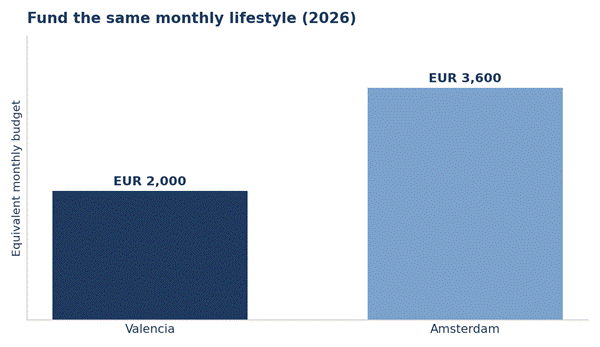
Figure 1: Cost-of-living data in 2026 suggests you need around 80 percent more in Amsterdam to fund the same lifestyle as in Valencia.
The EU-citizen advantage
This is the easy part. As a Dutch national you do not need a visa and you have the right to live and work in Spain. What you do need is to register: apply for your NIE and green EU registration certificate, and sign on to the padron (empadronamiento) at the town hall. Both unlock everything that follows, from a bank account to healthcare. Our general first-month checklist for moving to Valencia walks through the exact order and the appointments to book first.
Leaving the Netherlands properly
A clean exit saves you tax and admin headaches later. If you are leaving for more than eight months, deregister from your Dutch municipality (uitschrijven uit de BRP) at the gemeente; this is what formally ends your residence in the Netherlands and stops obligations like your Dutch health-insurance premium. Keep your DigiD, you will still need it for Dutch pensions, the Belastingdienst and other online services, and tell the Belastingdienst and your bank, pension fund and insurers that you are emigrating.
The admin swap looks roughly like this:
| In the Netherlands | In Valencia / Spain |
| BSN (citizen number) | NIE (foreigner ID and tax number) |
| BRP registration at the gemeente | Empadronamiento (padron) at the ayuntamiento |
| DigiD | Cl@ve / digital certificate |
| Zorgverzekering (health insurance) | Public SIP card or private insurance |
| Dutch driving licence | Valid in Spain; exchange, no test |
Tax: becoming a Spanish resident (and the Beckham Law)
Spend more than 183 days a year in Spain and you become a Spanish tax resident, taxed here on your worldwide income. The Netherlands and Spain have a double-taxation treaty, so you will not be taxed twice on the same income, but you do need to get your residency and filing right, which is where good local tax advice pays for itself.
One option worth knowing about is the Beckham Law (the special impatriate regime). If you move to Spain for work, as an employee or on a digital nomad visa arrangement, you can apply to be taxed at a flat 24 percent on your Spanish employment income up to 600,000 euros for six years, instead of the usual progressive rates, and most foreign-source income is exempt. To qualify you must not have been a Spanish tax resident in the previous five years and must apply within six months of registering for social security. It is especially attractive for Dutch professionals relocating with a job or working remotely for an employer.
Healthcare: from zorgverzekering to the SIP card
When you deregister in the Netherlands your Dutch health insurance ends, so plan the handover. If you work in Spain and pay social security, you and your family join the public system and get your SIP card. Dutch state pensioners should ask about the S1 form, which can give access to Spanish public healthcare funded by the Netherlands. The EHIC covers emergencies only and is never a substitute for proper cover, so if you are not yet working, take out private insurance to bridge the gap. We cover the full healthcare picture, including how affordable and high-quality it is, in our moving to Valencia guide.
Money, pensions and driving
Open a Spanish bank account for rent, utilities and direct debits, and use a low-cost transfer service such as Wise to move euros without heavy fees. Your Dutch AOW and any occupational pension can be paid to you in Spain; tell the SVB and your pension provider your new address and tax situation. On the road, your Dutch driving licence is valid in Spain and, as an EU licence, easy to exchange with no test, though you should register it with the Spanish traffic authority (DGT) once resident.
Schools and family life
Valencia is a superb place to raise children, and Dutch families have plenty of options: strong public and semi-private (concertado) Spanish schools, a cluster of international and bilingual schools, and supplementary Dutch-language education (Nederlandse Taal en Cultuur) so children keep up their Dutch. Many families settle near the school-belt suburbs of Godella and Rocafort or in green, central barrios by the Turia park. The city consistently ranks at or near the top of global expat surveys for family life and safety.

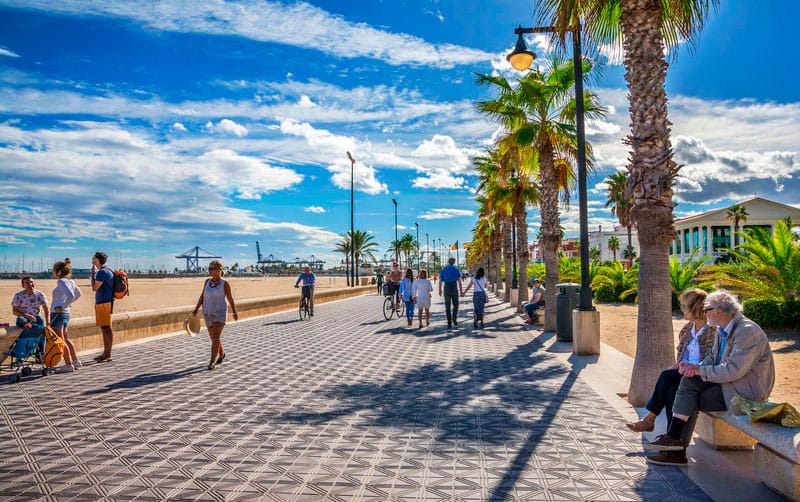
Family life in the Turia gardens, the green heart running through the city.
Getting there and staying connected
Practicalities make Valencia feel close to home. There are frequent direct flights between Valencia and Amsterdam (and seasonal links to other Dutch airports), typically around two and a half hours, so friends and family are an easy weekend away. Between the airport, the metro and a genuinely international city, staying connected to the Netherlands is effortless.
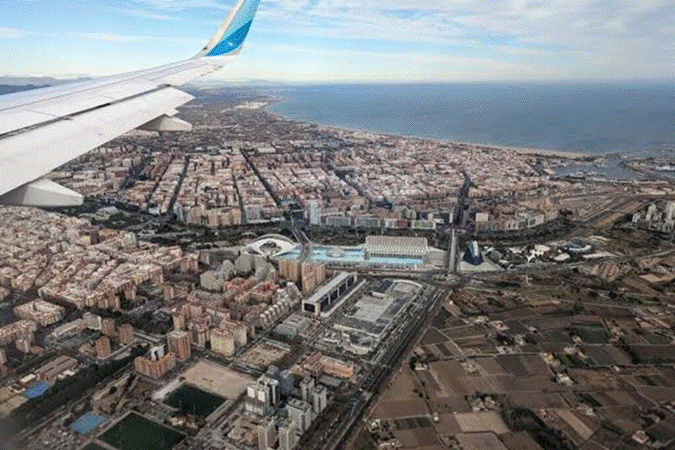
Valencia from the air: frequent direct flights put Amsterdam around two and a half hours away.
Frequently asked questions
Do I need a visa to move to Valencia from the Netherlands?
No. As a Dutch (EU) citizen you have the right to live and work in Spain. You only need to register, your NIE and green certificate, and the padron, rather than apply for a visa.
What is the Beckham Law and could it help me?
It is a special tax regime that lets qualifying people who move to Spain for work pay a flat 24 percent on Spanish employment income up to 600,000 euros for six years. It suits many Dutch employees and remote workers; you must apply within six months of starting social security and not have been a Spanish tax resident in the prior five years.
Can I keep my Dutch pension and healthcare?
Your Dutch AOW and occupational pensions can be paid in Spain. Dutch health insurance ends when you deregister; pensioners may use the S1 form, workers join the Spanish public system, and others take private cover.
How far is Valencia from the Netherlands?
Direct flights from Amsterdam take around two and a half hours, with frequent services, so it is very manageable for regular trips home.
Can Homevested organise my move?
Yes. Our relocation team handles the home search, appointments and paperwork so you arrive with everything in place. See what is included and typical costs in our relocation services guide.
Bring your move to Valencia to life
Swapping Dutch grey for Valencian sun is one of the best moves you can make, and doing it in the right order makes it painless. Tell us your timeframe, budget and whether you are renting or buying, and we will map the whole thing out. Contact us or explore our relocation services to begin.