


Moving to Valencia is one of the best decisions you can make, but the first month is where the dream meets Spanish bureaucracy. Between your NIE, your padron, a bank account and a place to live, there is a specific order that makes everything faster, and a wrong order that leaves you stuck waiting for appointments you could have booked weeks earlier.
This guide walks you through exactly what to arrange in your first month in Valencia, week by week, whether you are arriving from the Netherlands, the UK, the US or anywhere else. Follow it and you will go from suitcase to settled without the usual stress.
Before you arrive: get a head start
The smoothest moves begin before the plane lands. If you are a non-EU citizen, your visa must be approved before you travel. Everyone should book temporary accommodation for the first four to eight weeks, and gather the documents that Spanish offices will ask for again and again. Where documents are not in Spanish, get them officially translated and, where needed, apostilled.
Pack and prepare these essentials:
- A passport valid for your whole stay, plus several photocopies
- Your visa or residence authorisation, if you are a non-EU citizen
- Proof of funds, income or pension (bank statements, a work contract, or a pension letter)
- Birth and marriage certificates, ideally apostilled and officially translated
- A handful of passport photos for official cards and forms
It also pays to sort your money out before you fly: open a multi-currency or transfer account such as Wise so you can move funds cheaply once your Spanish account is ready, and tell your home bank you are relocating so your cards and transfers are not blocked for unusual activity.
EU vs non-EU: two slightly different paths
Your nationality decides part of the process. EU, EEA and Swiss citizens have the right to live and work in Spain; you register for a NIE and receive a green EU registration certificate, and you do not need a visa. Non-EU citizens (for example from the UK or the US) must first obtain a visa, such as the digital nomad, non-lucrative or work visa, before arriving, and then convert it into a TIE residence card within 30 days of entering Spain. Both groups need a NIE, and both should register on the padron.
One common misunderstanding: EU citizens do not need a visa, but if you intend to stay longer than three months you are still legally required to register and obtain your NIE certificate, so it is not a step to skip.
Week 1: a roof, a SIM card, and your first appointments
Temporary accommodation
Book four to eight weeks of short-term housing, a mid-term rental, aparthotel or similar, so you have an address and room to breathe while you find a long-term home. Many landlords want to meet you in person and see your NIE and finances before signing a one-year lease, so a temporary base buys you time. If you would rather arrive with this handled, our relocation team can line up accommodation before you land.
A Spanish phone number
Pick up a local SIM in your first days, prepaid from Movistar, Vodafone or Orange, or a low-cost option like Lowi or Digi. A Spanish mobile number is needed for appointment confirmations, bank security codes and almost every government portal.
Start booking your citas previas (appointments) immediately
The real bottleneck in Spain is the cita previa. Appointments for the NIE or TIE and other offices are often booked out weeks ahead, so reserve them on day one, even before you feel ready. A simple routine:
- Decide which appointments you need: padron, NIE or TIE, and social security if you will work
- Use the official booking portals (sede electronica) and keep checking for cancellations and earlier slots
- Turn up with printed confirmations, every form completed, and the exact fee paid in advance where required
Week 2: register on the padron (empadronamiento)
Empadronamiento is registering on the Padron Municipal at the Ayuntamiento de Valencia. It is free, usually takes one appointment, and your passport is enough, you do not need a NIE first. In fact, doing the padron early often speeds up your other appointments. The padron certificate unlocks public healthcare, school places and your SIP card, and is required for many later steps, so make it a priority.
Bring with you:
- Passports for everyone being registered at the address
- Your rental contract, or the owner's written authorisation to register
- A recent utility bill for the address, if requested
- The completed padron application form
Week 2 to 3: get your NIE (and your TIE if you are non-EU)
The NIE (Numero de Identidad de Extranjero) is your foreigner ID and tax number, and you will need it for almost everything: signing a lease, opening a resident bank account, paying taxes, buying a car, and buying property.

Spanish admin runs on paperwork, so gather, translate and apostille your documents before you start booking appointments.
If you are an EU citizen
Register at the Oficina de Extranjeria or a designated police station. You receive your NIE on the green EU registration certificate (Certificado de Registro de Ciudadano de la Union). Bring your passport, the completed EX-18 form, proof you have paid the Modelo 790 fee, and evidence you can support yourself through work, self-employment or sufficient funds plus health cover.
If you are a non-EU citizen
You should already hold your visa. Within 30 days of arriving, apply for your TIE (Tarjeta de Identidad de Extranjero), the physical residence card that carries your NIE. Book the cita, submit form EX-17, pay the Modelo 790 code 012 fee, give your fingerprints, and collect the card a few weeks later.
Good to know: if you only need a NIE in order to buy property, you can apply for a standalone NIE without residency, either at a Spanish consulate before you move or in person once you are here.
Week 2 to 3: open a Spanish bank account
You will need a Spanish account for rent, utilities, taxes and direct debits. You have two routes: a non-resident account (passport plus a certificate of non-residency, quick to open) or a resident account (NIE, padron and proof of income). Major banks such as CaixaBank, Banco Sabadell and BBVA have English-speaking branches, while digital options like Wise, N26 and Revolut are excellent for moving your money over and covering the first few weeks, though some Spanish direct debits and mortgage lenders still prefer a traditional Spanish bank.
Typically required to open an account:
- Passport and NIE (or a certificate of non-residency for a non-resident account)
- Proof of address, where your padron certificate helps
- Proof of income, employment or pension
- A Spanish phone number and an email address
Week 3: sort out your healthcare
Here is some welcome news, especially if you are arriving from a country like the United States: healthcare in Spain is largely free. The public system, the Sistema Nacional de Salud, is funded through taxes and social security rather than billed per visit, so once you are in it you generally pay nothing to see your GP, get a referral, see a specialist or be treated in hospital, and contribute only a small share towards prescriptions. Spanish healthcare is consistently ranked among the best in the world, and it is one of the things newcomers come to value most.
In an emergency, everyone is treated
If you have a genuine emergency, that safety net covers everyone. Spanish public hospitals will treat anyone who arrives needing urgent care, with no private insurance and no paperwork required first, so you will never be turned away when it matters most. If you are registered in the system the treatment is free; visitors from outside the EU who have no cover may receive a bill afterwards, but the care always comes first.
For everyday care, you use your SIP card
For routine, non-emergency care, booking a GP appointment, getting referrals or seeing a specialist, you need to be registered in the public system and carry your SIP card (Tarjeta Sanitaria). If you work and pay into Spanish social security, you and your family are entitled to it: register at your local health centre (centro de salud) with your padron and social security number to receive your SIP card and an assigned GP. If you are not working, you will usually need private health insurance to start with, commonly 50 to 150 euros a month, which is also a requirement for the non-lucrative and digital nomad visas. After a period of residence you can join the public system through the convenio especial pay-in scheme, and reforms introduced in 2026 have made access to a public health card more universal for people who can show at least six months of residence in Spain.
Two useful tips: EU pensioners should ask about the S1 form, which grants access to Spanish public healthcare funded by their home country, and the EHIC or GHIC covers EU and UK visitors for emergencies only, so it is never a substitute for proper residency cover.
Week 3 to 4: connect utilities and internet
If you are renting, electricity and water may already be connected, so you simply switch the contract or direct debit into your name. For a purchase or an empty property you will set up new contracts. Arrange your internet or fibre early (Movistar, Orange, Digi and others), as installation can take a week or two. Set everything to direct debit from your Spanish account so nothing lapses.
Week 4: from temporary to long-term home
With your NIE, padron and bank account in place, you are now a credible tenant or buyer. Most newcomers rent first to get to know the neighbourhoods, then buy once they are sure. Landlords usually ask for a one-month deposit (the fianza), sometimes an extra guarantee, and proof of income. For a long-term rental contract the agency fee is generally paid by the landlord, though the tenant is usually responsible for an administrative fee; for a seasonal (short-term) contract, the agency fee is paid by the tenant. When you are ready to buy, our step-by-step buying guide walks you through the whole process.

Once the admin is done, the fun begins: getting to know Valencia's neighbourhoods and finding a long-term home.
Other essentials people forget
- Driving licence: EU and EEA licences are valid and easy to exchange, and the UK has an exchange agreement; other nationalities may need to sit the Spanish test, so check your country's rules early.
- Social security number (NUSS): you will need one if you work or register as self-employed (autonomo).
- Digital certificate or Cl@ve: a digital ID that lets you handle admin online and skip queues, set it up once you have your NIE.
- Schools: register early, as your padron sets your catchment area and good state and international schools fill up fast.
- Spanish: even basic Spanish makes every appointment smoother, so consider lessons from week one.
How much should your first month cost?
Beyond rent and flights, budget for the one-off setup costs: official translations and apostilles, the modest Modelo 790 card and certificate fees (typically tens of euros), private health insurance if you need it, and a rental deposit of one to two months. If you would like a hand with the whole arrival, our guide to relocation services in Valencia breaks down what professional support typically costs and what is included.
Your first month in Valencia at a glance
| When | What to arrange | Where / how |
| Before arrival | Visa (non-EU), documents, temporary home, Spanish SIM | Consulate, online, agencies |
| Week 1 | Accommodation, phone number, book all appointments | Short-term rental, telecom shop, sede electronica |
| Week 2 | Empadronamiento (padron certificate) | Ayuntamiento de Valencia |
| Week 2 to 3 | NIE plus EU certificate, or TIE card; bank account | Extranjeria / police; your bank |
| Week 3 | Healthcare (SIP or private), social security | Health centre, insurer, Seguridad Social |
| Week 3 to 4 | Utilities, internet, direct debits | Providers, online |
| Week 4 | Long-term home, driving licence, schools | Estate agent, Trafico, schools |
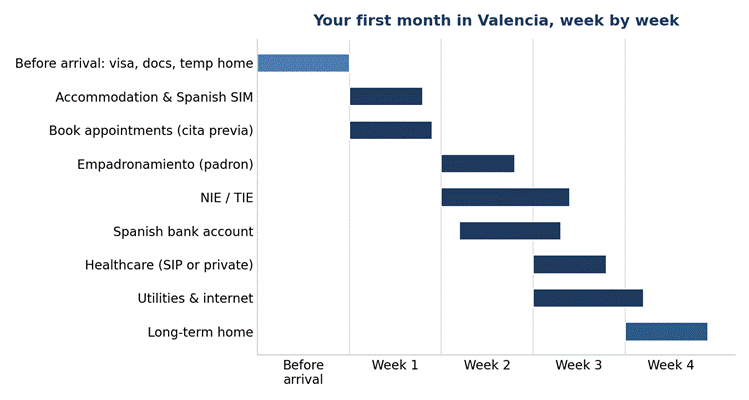
Figure 1: A typical first-month timeline in Valencia. Several steps overlap, so book your appointments as early as you can.
Frequently asked questions
Do I need a NIE before I can rent in Valencia?
Most landlords and agencies ask for your NIE to sign a long-term contract. You can usually sign short-term or temporary accommodation with just your passport, which is exactly why arranging temporary housing first is so useful.
Can I get my padron without a NIE?
Yes. Empadronamiento only requires your passport and proof of address, and registering early often speeds up your other appointments.
How long does the whole process take?
With appointments booked promptly, most people are largely set up, padron done, NIE or TIE in progress, and a bank account open, within two to four weeks. The physical NIE or TIE card itself can take a few extra weeks to be issued.
What is the difference between a NIE and a TIE?
The NIE is your foreigner identification number. The TIE is the physical residence card, for non-EU residents, that displays that number. EU citizens receive the number on a green certificate instead of a card.
Can Homevested handle all of this for me?
Yes. Our relocation team can line up your accommodation, appointments and paperwork so you arrive with everything already in place.
Is healthcare in Spain free?
For residents in the public system, essentially yes. It is funded through taxes and social security, so GP visits, specialist referrals and hospital treatment are free at the point of use, with only a small contribution towards prescriptions. Emergency care is provided to everyone, even without insurance or paperwork. For routine care you simply need to be registered and carry your SIP card, and if you are not yet working in Spain you may need private cover until you qualify.
Is Valencia a good place to move to?
For most newcomers, yes: it pairs a big-city offering with beaches, sunshine and a famously relaxed pace, at a lower cost of living than many Northern European cities. Our guide to the best areas to live in Valencia is a good place to start.
Make your move to Valencia simple
Moving to Valencia should feel exciting, not exhausting. If you would like us to organise your arrival, from finding the right neighbourhood and home to handling the NIE, padron and bank account, we are here to help. Tell us your timeframe and budget and we will map out your first month for you. Contact us or explore our relocation services to get started.