


Owning a rental in Valencia is a good place to be. Demand is high, supply is tight, and values keep rising. But managing a rental property in Valencia from abroad is a different job from owning one. Distance, language and Spanish tax turn what looks passive into real work.
This guide covers everything managing a rental property in Valencia from abroad involves in 2026. You will see what management includes, how to screen tenants, the tax you must file, the new short-let rules, and how to handle trouble. The goal is simple: keep the property profitable, compliant and low-stress while you live somewhere else.
Managing a rental property in Valencia from abroad: the real challenge
Managing a rental property in Valencia from abroad tests you in small ways every week. You cannot show the flat or meet applicants. Contracts and letters arrive in Spanish. A burst pipe at 9pm needs a trusted plumber you do not have. Tax deadlines do not wait for you to notice.
Add the empty months that creep in between tenants, and a good asset quietly underperforms. Owners who do well take one of two routes. They build a reliable local network, or they hand the job to a professional manager. This guide helps you do either.
What managing a Valencia rental from abroad involves
Full-service management is much more than collecting rent. It covers marketing and listing the property, finding and screening tenants, and drawing up compliant contracts. It also means collecting rent, chasing arrears, arranging repairs, running inspections, and handling the deposit and the tax. In short, it is the local point of contact a tenant can actually reach. Our companion guide to what a property manager actually does in Valencia breaks the day-to-day down in detail.
Build a reliable local team
A Valencia rental runs on local people you trust. Managing a rental property in Valencia from abroad gets far easier with the right local team. At a minimum you want a good gestor or tax adviser to handle filings. You also want an English-speaking lawyer for the contract and any disputes. Add a short list of tried tradespeople: a plumber, an electrician and a handyman who answer the phone and invoice properly. A reliable cleaner and a locksmith complete the set.
Just as important is an emergency protocol. Decide who the tenant calls at night. Set who can spend up to a fixed amount without asking you first. Agree how repairs are documented and paid. Owners who set this up before the first tenant moves in sleep far better than those who scramble when the boiler fails in the middle of the night.
Marketing and re-letting quickly from abroad
Empty months are the silent killer of rental returns. They are also the hardest thing to control from a distance. The fixes are unglamorous but effective. Price the flat to the real market, not to your hopes. Present it well, with bright, honest photos. List it on the portals where tenants actually look, and start before the current tenant leaves. Good tenants also renew when you look after them, so the cheapest re-let is the one you avoid. A flat re-let in a week rather than a month can pay for a year of management.
Screening tenants the Spanish way
Good tenants are the whole game. Screening is where remote owners are most exposed, because you cannot look someone in the eye. The local standard is clear. Ask for proof of income of around three times the rent. Ask for a work contract or payslips, or pension and savings evidence. Take recent bank statements, and often a guarantor or a rental-default insurance policy.
A person on the ground can verify documents and meet applicants in person. They read signals you simply cannot from abroad. Getting this stage right is your best protection against arrears and eviction. It is worth far more than shaving a little off the rent to fill the flat a week sooner.

Good tenants are the whole game, and a local manager can meet and vet them in person as you cannot from abroad.
Insuring against the worst
Insurance is cheap next to what it protects. You want building insurance, which the community of owners often requires. Then add landlord cover. Rental-default insurance (seguro de impago de alquiler) pays the rent and usually the legal costs if a tenant stops paying. Public-liability cover protects you if someone is hurt in the property. For a modest premium, two of the scenarios that most frighten remote owners become insured events.
The contract and the legal must-haves
A compliant let starts with the right paperwork. Use a proper long-term LAU contract, or a correctly framed seasonal one. Add a signed inventory for a furnished flat. Before letting, the property needs a valid energy performance certificate (CEE) attached to the contract. It often needs a habitation certificate (cedula de habitabilidad) too. Lodge the fianza with the regional housing authority; do not simply pocket it. None of this is hard, but all of it is the owner's job, and it is exactly what slips from a distance.
Maintenance and inspections: protecting the asset
A rental is a physical asset. It quietly deteriorates if no one watches. Small problems become expensive ones when they are left for months. Sensible owners schedule periodic inspections, with proper notice and within the tenant's rights. They service the air-conditioning and any boiler, and watch for damp, which Valencia's humidity encourages. From abroad you cannot see the slow drip under the sink. So build a routine with your local contact, or have a manager run and document regular checks with photos.
Keeping good tenants: renewals and rent reviews
The most profitable tenant is the one who renews. Every renewal saves a void, a re-let fee, a fresh inventory and the risk of an unknown replacement. So treat retention as a strategy. Respond quickly to reasonable requests and handle repairs without fuss. Be fair at review time; the IRAV index caps annual increases anyway. A short, friendly conversation a couple of months before the anniversary usually secures another year.
The tax you cannot ignore: non-resident income tax
If you are a non-resident landlord, Spain taxes your rental income through the Modelo 210 form. You file it with the Spanish Tax Agency. The rate is 19 percent for residents of the EU and EEA, and 24 percent for non-EU residents, including the UK. EU and EEA owners can deduct genuine expenses, so you are taxed on the net. A 2025 court ruling extended similar rights to non-EU owners. Rented-property returns are generally filed quarterly, so the admin is ongoing.
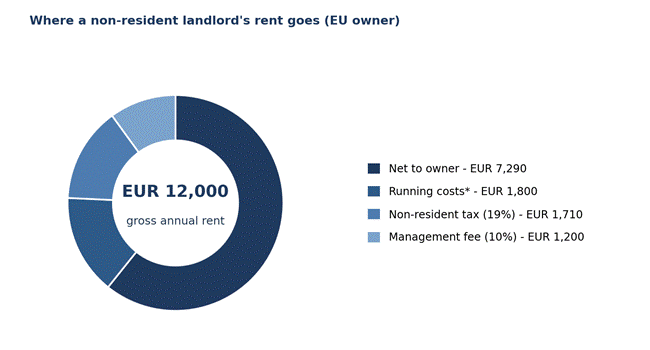
Figure 1: An illustrative split of 12,000 euros of annual rent for an EU non-resident owner, after costs, tax and management.
The lesson is simple. Judge a rental on its net return, after costs, tax and management, not on the headline rent. A gestor who files your Modelo 210 correctly, and captures every allowable deduction, usually pays for much of their own fee.
Do not forget the empty-property tax
Here is the part that surprises many owners. Even when the property is empty or used only by you, a non-resident still owes an annual imputed income tax. You declare it on the same Modelo 210. It is 1.1 percent of the cadastral value (or 2 percent if that value is not recent), taxed at your non-resident rate. The amounts are usually modest, but the filing is obligatory. In short, the Modelo 210 follows you whether the flat is let or not.
A worked tax example
Here is a simplified comparison for an EU non-resident owner. One year the flat is let; the next it sits empty. The figures are illustrative and depend on your rent, costs and cadastral value.
| Let for the year | Left empty | |
| Gross rent | EUR 12,000 | None |
| Deductible costs (EU owner) | ~ EUR 3,000 | n/a |
| Taxable base | ~ EUR 9,000 | 1.1% of cadastral value |
| Tax rate (EU) | 19% | 19% |
| Approx. tax due | ~ EUR 1,710 | Usually EUR 100-400 |
| Filing | Modelo 210 (quarterly) | Modelo 210 (annual) |
Short-term or long-term? Valencia's 2026 rules change the maths
Planning a tourist flat? Read this first. In late May 2026 Valencia brought in some of Spain's toughest short-let rules. Tourist use is capped at around 2 percent of homes in each neighbourhood. A whole area is declared saturated, and closed to new tourist licences, once tourist accommodation reaches 8 percent of residents. Letting individual rooms to tourists is banned. Every legal tourist flat needs the proper licence (the ETV), and you will still see them advertised on portals like Idealista. Owners even had a one-year window to convert tourist units back to homes.
For most remote owners this tilts the balance firmly towards long-term or mid-term letting. That model is steadier, lighter-touch and far less regulated. It is much easier to run from another country.
| Long-term let | Short-term / tourist | |
| Regulation (2026) | Lighter | Heavy: caps, licences, saturation zones |
| Income | Steadier, lower peak | Higher peak, more variable |
| Effort to run remotely | Low | High (turnovers, guests, compliance) |
| Void risk | Lower | Seasonal gaps |
| Best for | Hands-off owners | Licensed, actively managed units |

Valencia's rental market: high demand, tight supply and rising values.
Mid-term lets: the middle path
Between the year-long lease and the nightly tourist let sits a useful option. The mid-term or seasonal let runs one to eleven months. It suits relocating professionals, digital nomads, students and corporate tenants. It usually earns more than a standard long-term let, and it avoids the heavy tourist-licence regime. It does involve more turnovers, so it is best run with a manager. For a well-located furnished flat, it is often the sweet spot between income and simplicity.
What management costs, and when it is worth it
Fees scale with how hands-on the letting is. For long-term lets, full management usually runs around 8 to 12 percent of the monthly rent. A one-off tenant-find fee of about a month's rent is common on top. Mid-term management sits a little higher. Short-term or tourist management costs the most, often 15 to 25 percent, because of the constant turnovers.
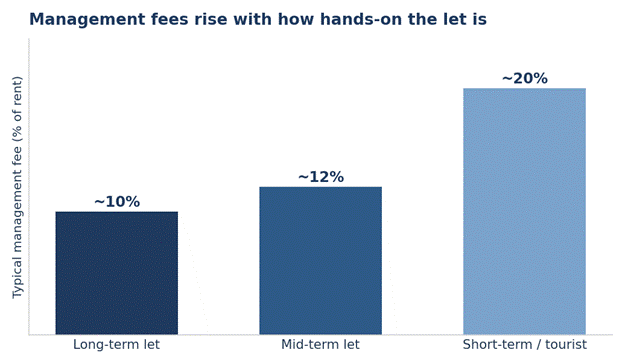
Figure 2: Indicative management fees by letting type. More turnover and compliance means a higher fee.
Set those percentages against the cost of a bad tenant, an unfilled month or a mishandled tax filing. Professional management usually earns its keep for owners abroad, before you count the time it saves. Want to sense-check the income side first? Our deep dive on rental returns in Valencia sets realistic expectations.
When non-payment happens
It is the risk every landlord worries about. So understand the process before you need it. If a tenant stops paying, you send a formal demand, usually by burofax. Then you file a court claim for eviction and unpaid rent (the desahucio). Realistically, an eviction for non-payment takes six to eighteen months, depending on the court and whether the tenant contests. A change in early 2026 removed the automatic suspensions that had slowed cases. A tenant in arrears has a one-time right to stay by paying everything owed (the enervacion). The defences are the ones we keep returning to. Screen well, use a solid contract, and take out rental-default insurance. From abroad, a manager or lawyer who can act at once is the difference between a contained problem and a runaway one.
DIY or professional management: a simple framework
There is no universal answer. It depends on your property, your distance and your appetite for admin. Managing a rental property in Valencia from abroad is mostly about systems and trust. Self-management can work if you are a short flight away, speak some Spanish, and let long-term to a well-screened tenant. Professional management tends to win when you are far away or in a different time zone, do not speak Spanish, own several units, or let short or mid-term. Many owners start out self-managing. Then they switch after the first 9pm call about a leak they cannot fix from another country.
Choosing a manager: what to ask
If you go the professional route, a few questions separate the good from the rest:
- Exactly what is included: tenant-find, rent collection, maintenance, inspections, tax filing, and what costs extra.
- How they screen tenants: their process for income checks, references and guarantees.
- How they handle repairs: their trades network, the spend they can authorise, and how they bill.
- Reporting: how often you get statements, and how they transfer your rent abroad.
- Compliance: whether they handle the Modelo 210, the deposit lodging and the certificates.
- Fees and notice: the full fee structure, and how easily you can leave.
Frequently asked questions
Do I pay tax on Valencia rent if I live abroad?
Yes. Non-resident landlords declare Spanish rental income on the Modelo 210. The rate is 19 percent for EU/EEA residents and 24 percent for non-EU. EU/EEA owners can deduct expenses, and even an empty property owes a small imputed tax.
Can I manage a rental property in Valencia from abroad on my own?
You can. It works best if you are a short flight away, speak some Spanish, have a reliable local contact, and let long-term. If not, a manager usually pays for itself in fewer voids, cleaner compliance and far less stress.
Can I run a tourist rental in Valencia in 2026?
Only within the strict new rules: neighbourhood caps, saturation-zone bans, a proper ETV licence, and no letting of individual rooms. Many owners are shifting to long-term or mid-term letting, which is simpler to run remotely.
How long does eviction take in Spain?
For non-payment, realistically six to eighteen months, depending on the court and whether the tenant contests. Thorough screening and rental-default insurance are your best protections.
How much does property management cost in Valencia?
Long-term management is typically 8 to 12 percent of the rent, plus a possible tenant-find fee. Mid-term and short-term cost more because of the extra work.
Can Homevested manage my property?
Yes. Our property management service handles tenants, maintenance, compliance, tax and reporting. So you can own in Valencia without living there, whether you bought a home or an investment.
Own in Valencia, live anywhere
A Valencia rental should work for you, not the other way round. Let us handle the tenants, the maintenance, the tax and the paperwork. That is what managing a rental property in Valencia from abroad should feel like: genuinely hands-off. Tell us about your property and your goals, and we will show you what it should earn. Contact us or explore our property management services.